
Ambedkar Vs Ambedkar
What changed between Ambedkar’s 1916 and 1936 accounts of caste? Reading his two essays alongside the Poona Pact, the Mandal dispute and his eventual exit from Hinduism, this piece questions the consistency of one of the most unquestioned figures in Indian public life.
Pramodh
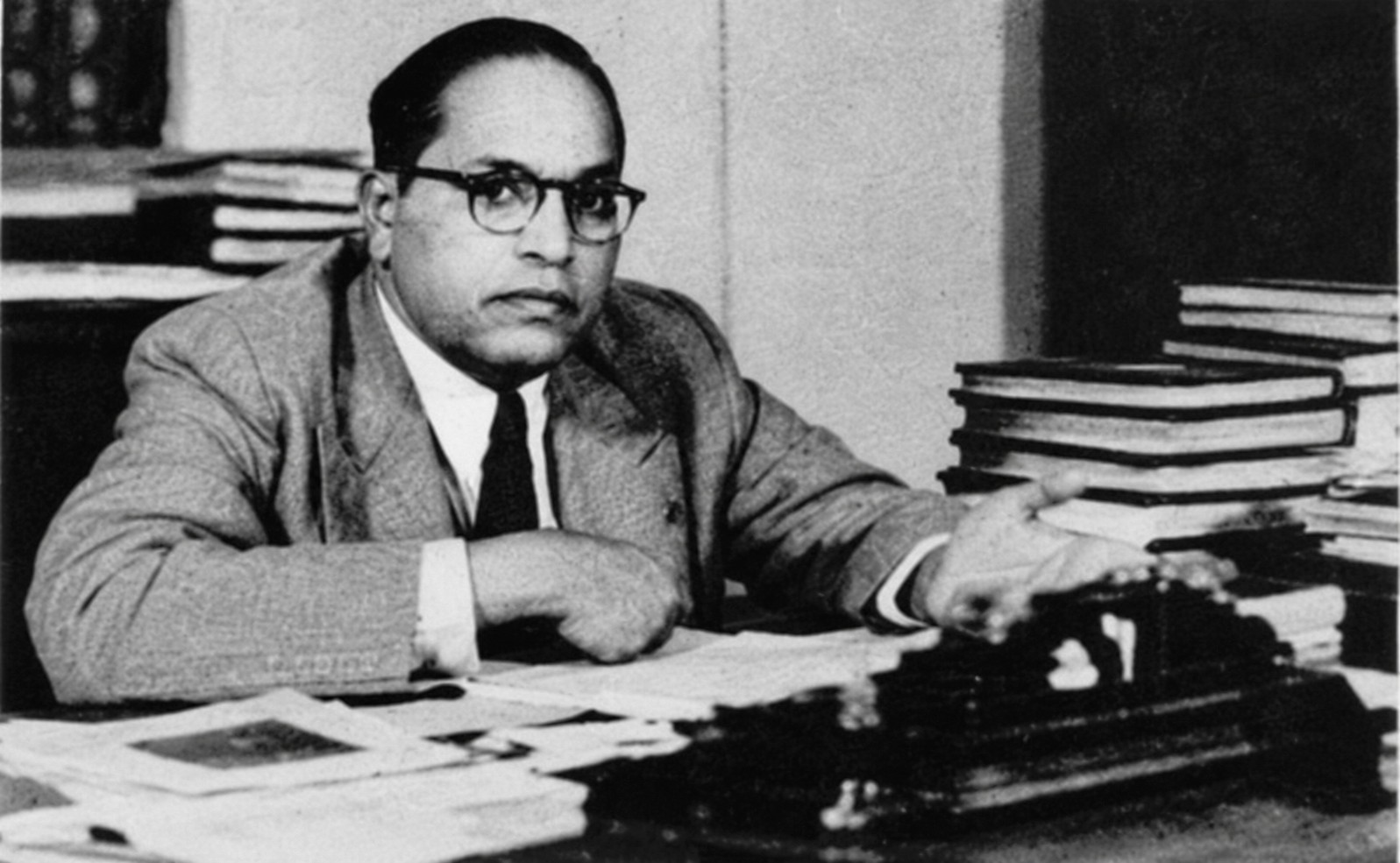
In May 1916, a twenty-five-year-old bright Indian student read a paper on caste to Alexander Goldenweiser’s anthropology seminar at Columbia University.1 Twenty years later he wrote an address for a reform society in Lahore that was never delivered.2 Both texts are about caste, and both are routinely quoted as though they make one argument. Well, they do not.
Dr BR Ambedkar invited the assumption himself. In 1944, he wrote that he had meant to recast the later essay to absorb the earlier one, and had given up for want of time.3 The merger never happened, and I suspect it never could have, because something in one text had to give way to the other. This inconsistency also raises a question on the reasons why the scholar changed his diagnosis?
The sociologist of 1916
Dr Ambedkar read “Castes in India: Their Mechanism, Genesis and Development” at an anthropological seminar of Alexander Goldenweiser in New York on 9 May, 1916. In this paper, Ambedkar explains that Caste has one defining feature, which is endogamy (marrying within a caste). Other features like Pollution, hereditary occupation and the bar on inter-dining are derivative of it.
Since the people of India were originally exogamous (marrying outside a group), with gotra rules punishing same-gotra marriage more severely than endogamy was ever punished, caste means the superposition of endogamy on exogamy. A closed group then needs roughly equal numbers of marriageable men and women.
Surplus women and surplus men must be disposed of, which gives us the ills of sati, enforced widowhood, girl marriage and imposed celibacy. These customs, he argues, were means, and the philosophies praising them came afterwards to “gild the pill”.4
The spread of caste is explained the same way. Lower groups imitated the Brahmins, following Tarde’s law that imitation flows from the prestigious to the near. When a certain community closes its doors on the rest, it by implication means the rest are closed inwards.
Ambedkar rejects the idea that Manu or the Brahmins imposed caste on the rest. Manu codified what existed, and the imposition theory is “incorrect in thought and malicious in intent”. He adds that religious sanction is no scientific explanation of caste, and that preaching neither made it nor will unmake it.5
Therefore, spread of caste is purely mechanical and has no religious or spiritual backing. Caste is a solution to a marriage-market problem, spread by prestige and policed by excommunication. Belief enters late, more so as a prop.
The prosecutor of 1936
In 1936, Dr. B. R. Ambedkar was invited by the Jat-Pat Todak Mandal, a Lahore-based Hindu reformist organization, to deliver the presidential address at their annual conference, but when the committee reviewed his advance draft, they deemed his direct denunciation of orthodox Hindu scriptures unacceptable and demanded revisions. Ambedkar refused to do so, leading him to self-publish the undelivered speech at his own expense under the title “Annihilation of Caste”.
One can observe that Ambedkar’s Lahore address prosecutes a different case. In this, Caste becomes “a notion, a state of mind”. Hindus observe it because they are deeply religious, and “people are not wrong in observing Caste”. The enemy is the Shastras, and the remedy is to “apply the dynamite to the Vedas”.6 The mechanism has dropped out and a theology has taken its place.
Three conflicts follow from this:
In 1916, he starts from the assumption that India possesses an “indubitable cultural unity” across the whole country, and he treats cultural unity as the real test of homogeneity. This assumption is what makes caste seem puzzling: if India is already culturally one, then caste looks like a division imposed on something that is already whole.7
But in his 1936 address, Ambedkar sharply reverses this assessment. He says that “Hindu Society is a myth”, that there is only a collection of castes, and that shared habits and beliefs do not prove that a society exists because culture can spread by diffusion, whereas a society requires communication.8
In the 1916 paper, Ambedkar was pointing at a culturally united and homogeneous society; upon which division was imposed, but in 1936, he was pointing towards caste groups as the fundamental units in a region where no cultural unity existed. The problem is that the 1916 paper never distinguishes between similarity and community; its whole argument depends on similarity doing the work of proving unity.
Second, the two texts reverse the direction of causation. In the 1916 paper, customs come first and theology follows: belief is treated as a late support for caste, not its root. In the 1936 address, by contrast, theology is the cause. One could object that the two texts are answering different questions: the 1916 paper explains the origins of caste, while the 1936 address explains its maintenance and the 1916 paper does concede that caste eventually “relies on belief.”
But if religious sanctity, i.e., belief attached to caste is a relatively late phenomena to an already existing practice, then belief is not the thing a reformer would primarily set out to demolish. If the 1916 causal account is right, the real operative target is the marriage market, who is allowed to marry whom, and at what cost to the couple.
A reformer accepting that account would focus on the penalties for crossing caste lines, the economic dependence that makes families enforce the rule, and the availability of alternatives. S/He would not write to a reform society telling it to attack scripture.
Third, the two texts disagree about how caste spreads. The question is does it spread by free imitation or by imposed authority. The 1916 paper says caste spread through voluntary imitation and rejects the idea that Brahmins maliciously imposed it. The 1936 speech, by contrast, describes a system in which people with “the authority to force it on their inferiors” established caste, and he calls this “Brahminism incarnate.”9
His own examples of the Sonars and the Pathare Prabhus show Peshwa-era Brahmins stopping a community from adopting Brahmin ways.10 But Tarde’s mechanism of imitation requires imitators who are free to imitate; the Sonar case shows imitation being policed from above. One might try to reconcile the two by saying that 1916 describes the genesis of caste and 1936 describes its enforcement. But the 1916 paper never says it is describing only one phase, and its rejection of the imposition theory is categorical.
There is a smaller inconsistency too. ==In 1936, Ambedkar praised the Mauryan period as one in which caste was “completely annihilated.”11 That sits awkwardly beside the 1916 picture of caste as so ancient and so deeply embedded that it needed no outside support.== In any case, it must be noted that many historians dispute the Mauryan claim.
The strongest evidence is Ambedkar’s own
The 1936 speech contains a concession that undermines its own thesis. In section 19, he grants that Muslims, Sikhs and Christians have castes too, though without scriptural sanction and without excommunication for breach.12 So caste exists even where no Shastra commands it. That is precisely the 1916 position. If endogamy can be sustained by social pressure without a sacred text, then destroying the text will not dissolve the problem. The 1936 speech records this fact in its own pages and then argues past it.
Modern reality has not been kind to the 1936 theological explanation of caste either. Large numbers of Indians now live and work in cities with no practical connection to the Shastras, yet inter-caste marriage remains less frequent than expected. Caste persists among people who have never read a smriti and would not even know what prayaschitta means.
The 1916 account which treats caste as sustained by social pressure and endogamy rather than scripture predicts this outcome. The 1936 account, which treats scripture/ideology as the cause, has difficulty explaining it.
So what explains this change?
The attendant circumstances to 1936 explains much. By October 1935, at Yeola, Ambedkar had announced that he would not die a Hindu. By the time he wrote the Lahore address he had decided to leave, and the speech says so.13 A man who has resolved to leave a religion needs a case against that religion. The reform society that invited him wanted inter-dining and inter-marriage drives, and he told them these were futile and that the Shastras were the target. The argument had a destination before it had a premise.
The 1916 student was explaining a puzzle, while the 1936 leader was building a case for a verdict he had already reached. The first sought an explanation, and the second sought a conviction.
In 1932, he had signed the Poona Pact, giving up the separate electorates the Communal Award had granted him, under the pressure of Gandhi’s fast. In 1936 the correspondence with the Mandal shows him refusing to alter “a comma” of the address, telling Har Bhagwan that he would not use their platform to argue for conversion, and then closing the address with his departure. He also blamed the cancellation partly on his attendance at the Sikh Prachar Conference in Amritsar.14
Sikh, Muslim and Christian leaders were then openly courting Depressed Class leaders, and the threat of a mass exit had bargaining value. His Independent Labour Party followed that same year. I cannot prove motive, and sincerity and strategy can co-exist in one man, but a change in position, that arrives right at the threshold of exit from the religion, a new political party and a bargaining position to exit religion enmasse, deserves to be read with all three in view.
At the threshold, a fair objection to deal with is that the two papers answer different questions for different readers. The 1916 paper was a seminar exercise addressed to anthropologists, and it asks how caste is built. The 1936 address was written for reformers who wanted to know why their dinners and weddings had failed, and it asks what holds caste up. A sociologist may hold both views without contradiction.
The issue is that the 1936 paper does not explain so. It presents itself as the diagnosis, and it dismisses the reformers’ method on the strength of that diagnosis. The 1916 mechanism, which would have favoured their method, is never accounted for. That does not, by any measure, make the later text false.
Its only explains how scriptural authority shut down reasoning, and the passages on prayaschitta and sadachar remain among the best things written on how a tradition protects itself from reflection.15 But a good indictment can rest on a weaker causal theory than the one its author held at twenty-five.
A borrowed toolkit
The authorities cited in the 1916 paper are Senart, Nesfield, Risley, Ibbetson and Ketkar, which is essentially the ethnographic canon of the British Raj. He argues against its theories but accepts its categories, including the Aryan, Dravidian and Scythian stocks.16 The authorities cited in the 1936 paper are Dicey, Dewey, Burke, Lassalle, Carver and Brailsford. Both essays are the work of a brilliant student of Western social science, trained at Columbia and London, applying whatever the library offered to a problem he knew from the inside. The only catch is, when the library changed, so did the conclusion, or it could be that since the conclusion changed, the library did. Well, who knows?
His own standard for Gandhi
In his reply to Gandhi, Ambedkar mocks Mahatma Gandhi for moving from defending caste to defending varna. He calls it prevarication and asks, “Whom does he want to please?” He says Gandhi has “the simplicity of the child, with the child’s capacity for self-deception”, and that “politics have certainly commercialized him”.17 He traces Gandhi’s position to fear of losing political standing.
That standard that was set for Gandhi by Ambedkar cuts in both directions. A man who changes his account of caste between 1916 and 1936, and has a political reason to prefer the new account, can fairly be asked the same questions. The shift did not stop there. In 1936 he treated reform of the family, meaning widowhood and child marriage, as a lesser matter than breaking caste.18
The leader and the exit
This brings us to the claim that he led the cause of annihilating caste. His claim to leadership in other fields rests on the Constitution and the Poona Pact, and this essay does not touch those. On caste as a cause, a leader owes followers a stable diagnosis, and Ambedkar offered at least two conflicting positions, with no account of why he dropped the first. A follower of the 1916 position should organise around marriage and the economics of dependence. A follower of 1936 should organise around scripture. These are, in essence, different movements.
Then there is the exit. The 1936 address told Hindu reformers to destroy the authority of the Shastras, and told them in the same breath that he would not be within the fold. He promised to watch their movement “with active sympathy”.19 In October 1956, he converted to Buddhism at Nagpur. Exit is a different act from reform. A physician who diagnoses a disease in the village and moves to another one has made a choice with a cost, and the cost falls on those who stayed.
The fair reply is that the speech itself names the exit. It tells the reformers to take the stand that Buddha and Guru Nanak took, which was to deny the authority of the scriptures they inherited. Seen that way, Nagpur in 1956 is the 1936 argument carried out in practice. I accept that. But it sharpens the point about the diagnosis. The exit follows only if caste is a matter of scripture, so the rejection of the 1916 mechanism was the premise on which the whole later course of his life depended, and it was never argued with the care he gave the 1916 paper.
It is also unclear that conversion delivered what the 1936 theory predicts. If caste is Hindu theology, converts should have shed it. Distinctions persist among Indian Buddhists, Christians and Muslims, which is what 1936 paper, section 19 thereof concedes, and the paper of 1916 postulates.20
What follows for the reader
The 1916 paper ended with a promise, i.e., “if it can be shown to be untenable I shall be equally willing to give it up.”21 Ambedkar never showed it untenable. He never defended it against his later self, and the 1944 preface suggests he never saw the need. The two texts were reprinted and read side by side for decades, and each hardened into canon without reference to the other. A scholar who revises and changes one’s mind in two decades can be a virtue, and deserves all praise for the same. My objection is narrower and confined to the aspect of treating him as an oracle whose positions form one finished system, which can never be the case. It is unfortunate that students of Political Science quote the 1936 paper for the Shastras, and Anthropologists quote the 1916 paper for the structure, and the two camps rarely read each other.
A modernist reader has a reason to care which Ambedkar to follow. If the 1936 diagnosis is right, the cure is a reformation of religion, with the state licensing priests and one book replacing the rest, as he proposes in the same speech. If the 1916 diagnosis is right, the cure lies in law, economics and the slow construction of lives in which a family has less to lose when its children marry across lines. The second programme is more modest and far more consistent with what survives of the evidence.
In the preface to the second edition to the 1936 paper, he wrote that “the world owes much to rebels who would dare to argue in the face of the pontiff and insist that he is not infallible.” He was speaking of Gandhi. Given the modern deification of Ambedkar that applies to him as well, and I strongly believe he would appreciate questions being asked even to him.
Ambedkar the scientist explained how caste works. Ambedkar the prosecutor told us whom to blame. We have honoured the second while quietly relying on the first, and we should at least notice that the two disagree.
Footnotes
works discussed
-
B. R. Ambedkar, “Castes in India: Their Mechanism, Genesis and Development”, read 9 May 1916; Indian Antiquary 41 (May 1917). ↩
-
B. R. Ambedkar, Annihilation of Caste (1936). ↩
-
Annihilation of Caste, Preface to the Third Edition (1 December 1944). ↩
-
“Castes in India”, on endogamy, surplus man and woman, and the customs in question. ↩
-
“Castes in India”, on Manu, the Brahmins and religious sanction. ↩
-
Annihilation of Caste, section 20 and 22. ↩
-
“Castes in India”, opening argument. ↩
-
Annihilation of Caste, section 6. ↩
-
Annihilation of Caste, sections 5 and 24. ↩
-
Annihilation of Caste, section 9. ↩
-
Annihilation of Caste, section 17. ↩
-
Annihilation of Caste, section 19. ↩
-
Annihilation of Caste, section 26. Yeola declaration, 13 October 1935. ↩
-
Annihilation of Caste, Prologue, Ambedkar’s letter of 27 April 1936 to Har Bhagwan. ↩
-
Annihilation of Caste, section 22. ↩
-
“Castes in India”, opening argument on ethnic stocks. ↩
-
Annihilation of Caste, “A Reply to the Mahatma”, sections 9 and 10. ↩
-
Annihilation of Caste, section 2. ↩
-
Annihilation of Caste, section 26. ↩
-
Annihilation of Caste, section 19. ↩
-
“Castes in India”, concluding paragraph. ↩