
Just Being, Without Becoming
Romila Thapar’s memoir Just Being is a disappointingly unreflective, achievement-focused narrative that avoids self-criticism, meaningful engagement with critics, and broader historiographical debates. While it has occasional personal and humanizing moments, the book ultimately mirrors the insularity and decline of the Nehruvian academic elite Thapar represents.
A. Bhuvan Krishna
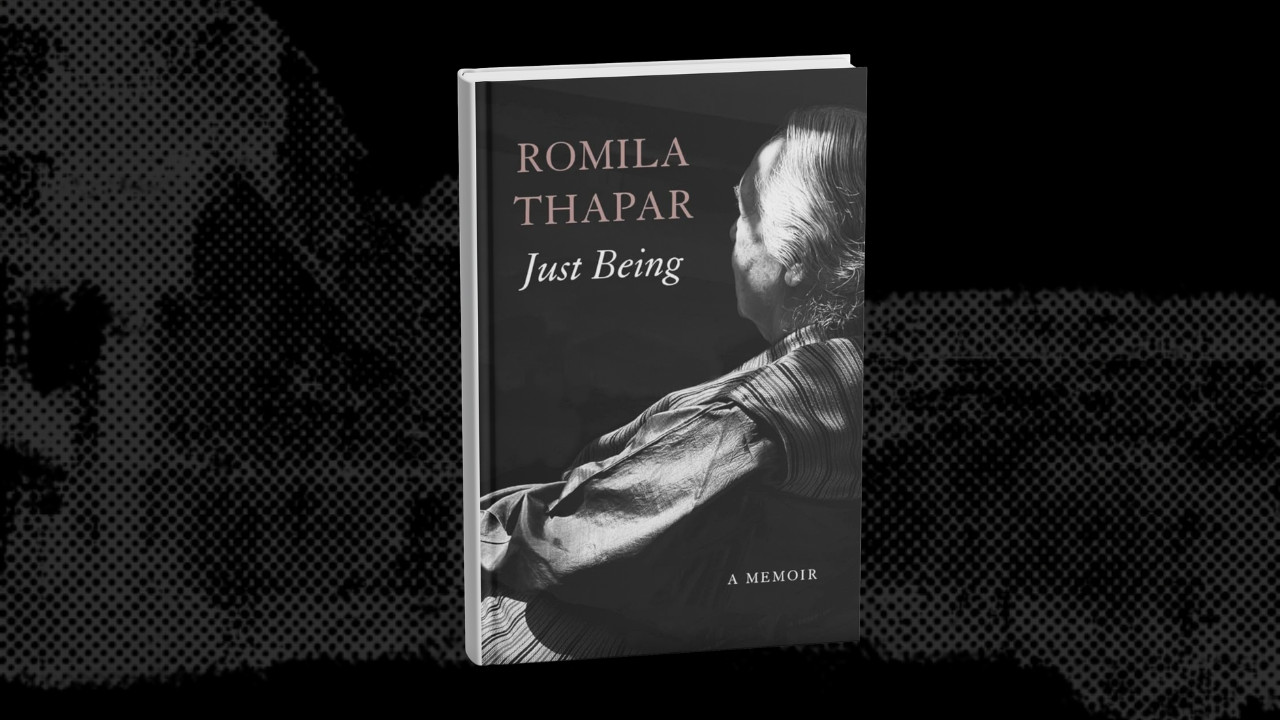
[read synopsis of Just Being: A Memoir by Romila Thapar]
Just Being: A Memoir is a 710-page autobiography by the eminent Indian historian Romila Thapar that reflects on her nine decades of life, intellectual growth, and her foundational role in shaping modern Indian historical studies. Published by Seagull Books, the memoir traces her journey from a privileged childhood in British India to her independent academic pursuit in London, followed by her return to post-independence India where she helped pioneer the Centre for Historical Studies at Jawaharlal Nehru University (JNU).
What is an Autobiography or a Memoir? Does it require a special vision, art, or personality? Or, more importantly, what is the nature of, and expectations from, a memoir written by an academic, specifically a historian? How is it different from one written by anyone else?
In their own well-known memoirs, historians Peter Brown and Eric Hobsbawm respectively stated that “Autobiography is not like straight history”1 and that, “Autobiography of a historian is an important part of the construction of his or her work.”2 Then there is another historian Robert Rosenstone telling us, “I wrote this work as a way to uncover the buzzing in my own bonnet. Those bees sting you with a topic, and it takes years to remove that stinger and come to an understanding of the lessons that were contained in the pain it gave you.”3
Following their lead, one can sum: awareness of one’s positionality, a profound reflective gaze over one’s own victories and failings, and confronting one’s own concealed emotions, motivations and reasons behind interests, are few elements that are expected in a biography of a sensitive historian. Renowned Indian historian Romila Thapar, impious as she is, seems to beg to differ.
In the very beginning of her memoir Just Being, published in mid-2026 by Seagull Books, she tells, “and then there is the problem that one is always leading two parallel lives — the visible and audible as distinct from the invisible, silent inner life…and it shall be about my visible life.” So, the historian offers us a linear narrative of her achievements and likes — a major bulk of which is already in public domain — the places she visited, the conferences she spoke at, and distantly, almost as if passively commenting upon the tumults of the time, sans any in-depth meditation on any of them as envisioned by Socrates when he declaimed that “an unexamined life is not worth living.” To Socrates’ rather demanding dictum, the historian continues, “as an academic I have become accustomed to my prose being measured and unadorned, and so it shall remain here too.”
The prosaic narration of life eventually comes out as a string of diary entries pieced together, ==with the reader pacing from one conference to another and one meeting to another to one party to another, almost sprinting behind the author, without getting to know any of the people involved== beyond their names or perhaps a title of their book, or a para at most — be it her doctoral supervisor, the celebrated Indologist A.L. Basham, her co-winner of Kluge Prize Peter Brown, her friend and another celebrity historian, Eric Hobsbawm, pioneering Marxist historian D.D. Kosambi, with whom she travelled by train once; her colleagues at CHS, who are all summed up in one-liners; or her many PhD students. It seems it is for Romila that A.J.P. Taylor stated that the rememberer “does not need to suppress his own personality…, but it must be used to illuminate others, not himself.”4 Indeed many Indian academics such as Tapan Raychaudhuri and Amartya Sen, among others, have recounted their life stories in reflective and witty ways, with that yet another missing ingredient — a healthy dose of self-criticism.
In an idiosyncratic way of my own, reading this, I was reminded of another influential woman’s memoir, who could not have been more different than our historian — the former British Prime Minister Margaret Thatcher’s The Path to Power (1995). The absolute similarity in style of recounting their life is stunning. What one reviewer wrote of Thatcher’s earlier volume of memoirs, The Downing Street Years (1993), captures the spirit of Romila’s as well — “there is practically no sense of perspective, still less a reflective appraisal of her own successes and failures, strengths and weaknesses. Occasionally something might have been done better, but mainly by somebody else.”5 One wonders: is it the androcentric hostility embedded in our public life that toughens up women to this extent, and saps their spontaneous emotionality, restrains them and turns their words to the textual equivalent of Kipling’s “stiff upper lip.” Also, I do not blame the author, at this advanced age, for the tedious repetitiveness and redundancy in the prose, but better was expected of her editors.
It is not that the book is totally bereft of any part of enduring value, but it is to be found in the most unexpected quarters — such as the wholesome descriptions of childhood — from Lahore to Peshawar to Poona — and the accompanying stories of “Mad Mullah” or her mild assertion of Punjabi identity. Perhaps the sweetest part of this entire memoir, where the historian appears as a human, is when she tells us how fond she is of her dogs with quintessential Nehruvian names — Amba, Ranjha, Bullhe — or when she philosophically quips while sitting in her garden. Or, in her reminiscences of her parents, the Thapar clan, and of her elder brother, Romesh, the renowned editor of Crossroads and Seminar, and his wife, Raj. The number of titles of books and music records that she mentions can be of interest to any attentive reader in either or both of the areas, and one can glean from these pages to find out about new authors, historians, and intellectuals to read about.
One running thread of this story is the historian’s foregrounding of her identity as a woman. ==She notes at the beginning, “I have asserted my autonomy as a free, liberated woman,” whose meaning and ramifications she ponders throughout.== This quest, beginning with the narrator, begins to illuminate other characters in the story as well, particularly her mother. As someone working on women’s issues, it was a joy to read about her mother, whose story, like the stories of many women of her generation, can only be read against the backdrop of their husbands’ and children’s lives, but in essence are midwives of a new and more progressive era. Romila laments her inability to contribute to feminist historiography. As feminist historiography has believed in personal narratives as an essential corrective to the otherwise male-written, male-populated world of archives and material evidence, Romila writing about her mother and other women in this story, in brief but lively remembrances, should take some rightful satisfaction of prāyaścitta.
However, when it comes to critics, unsuited for someone of her stature, ==Romila shows a resolute — almost stubborn refusal to engage with anyone who does not agree with her worldview.== One could have ignored this in a long memoir, if it had not become an unavoidable pattern. To illustrate, Wagish Shukla, a profound scholar of Hindi and Sanskrit and former professor of Mathematics at IIT Delhi, who, for writing a pointed and well-argued critique of Romila’s work Sakuntala,6 is bitterly conjured not once, not twice but thrice, only to be dismissed without even being given the courtesy of being named even once.7 Rather disingenuously, it is claimed that the “Hindi critic’s” major umbrage is with the feminist tone of her analysis. A more honest pūrva-pakṣa would have seen Shukla’s case as one for distinguishing between the narrative function of literary episodes and their presumed historical significance, and how the latter cannot simply be inferred from the former.
Perhaps, more bitingly, Shukla rather blankly points out Romila’s complete reliance on Barbara Miller and Monier-Williams’s sometimes faulty translations and lack of any direct access to the text, despite, as Romila herself recounts, her training in the language. Needless to say, one wonders why, if this review haunts her so much, she simply does not engage with its core contentions. In another instance, discussing her book Somanatha: The Many Voices of a History, Romila writes that it was universally applauded except by the expected ruffians of the Right; she doesn’t even consider the objections they may have raised, at least for the reader’s sake.
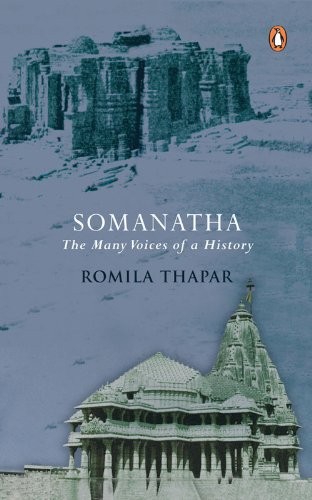
Given her refusal to even name her critics — and mind you, we are talking about critics writing in established mainstream newspapers and journals and not the social media trolls of our time — I can only guess she is referring to a bad review she got in India Today from journalist Chandan Mitra8 and a critical review of it in The Pioneer by Meenakshi Jain,9 an author and former associate professor of history at Gargi College of Delhi University. Incidentally, Jain was also one of the authors of the new NCERT textbooks commissioned by the Vajpayee-led NDA government which replaced ones written by Romila and others. Similarly, while writing about the Brahmana and Shramana relationship as equivalent to a bitter conflict between a snake and a mongoose and attributing it to Patanjali, she offers no comment on scholars such as Nathan McGovern, who have challenged that reading of Patanjali.10
While Romila spills enough ink explaining why Hindutva history “does not use a historical method of inquiry,” she has relatively little to say about the actual challenge to history as practiced today: the “cultural turn” in the Humanities and the onslaught of postmodernist critiques of History as a discipline. Today, when history appears to be, in words of Keith Jenkins, “one more foundationless positioned expression in a world of foundationless, positioned expressions,”11 it seems one of the best-known historians of her time has nothing to say on it at all, except for steadfastly asserting her faith in the positivist empirical approach. In contrast, Rosenstone, who, like Romila, acknowledges his training and inclination as “an empiricist,” narrates how, even before the onslaught of the postmodernist critiques, he critically introspected and found that the “boundaries of traditional historical writing were unnecessarily confining, mired in literary practices that did not allow me to produce works that expressed the full range of experience and emotion found in or suggested by the sources.”
Also, reading this memoir, one gets the impression that Romila has rarely allowed her world to be contaminated by anyone holding radically different political views from hers. Even her friend Eric Hobsbawm was known to be fond of much younger conservative historian Niall Ferguson. ==Such high regard for fellow academics across ideological lines has also been evident in Indian academia, with Marxist historian R.S. Sharma’s expression of respect for his conservative senior R.C. Majumdar.== But in the unidimensional view of Romila, who rightly points out that she is not a Marxist, it seems no one deemed conservative, however illustrious, could impress her — be it Jagdish Bhagwati (“tad more aggressive”) or V.S. Naipaul (“disappointing”). However, our protagonist proudly accepts any complimentary remarks from otherwise communal people, such as Dr. A. Sundara (who invited her to give a talk despite their differing views on the Babri dispute). Interestingly, Romila records her happiness at being complimented by Munish Chandra Joshi, a “conservative historian”, for one of her books. Incidentally, Joshi was head of ASI when Babri Masjid was demolished.
If her engagement with critics is dismal, Romila’s takes will also disappoint perceptive readers. In Vyasa’s Mahabharata, there is a well-known section of the Yakṣa Praśna, in which the Yakṣa asks the seminal question, “What is Dharma?” and after recounting the difficulties of ascertaining that elusive term, Yudhisthira replies: “…mahājano yena gataḥ sa panthāḥ”; that is, the path to follow is that of “mahājano”, which can either mean the noble men or the public. Interestingly, in our modern times, this dual meaning lies at the heart of the topical debate of who is responsible for the proliferation of spurious history: The popular historian with his cavalier attitude towards academic conventions or the academic, with his disdain for any engagement outside his ivory tower, leaving the space open for anyone with a keypad. Are they both equal contributors to the knowledge production process, or is there a hierarchy and a need for one?
The trap is built into the terms of the debate itself, the binary that seeks to draw a line, ensuring that no meaningful discussion can ever emerge. Unfortunately, Romila, rather than adding nuance to the discussion, further paints it in black and white, missing even the existing ones. ==For her, academic historians are those who write progressive history based on facts and method, and the popular historian who, curiously, is always a Hindutvawadi in disguise. What then does one make of Ramachandra Guha and William Dalrymple==, whom she would definitely have known and with whose work she would be familiar, or the much younger Manu S. Pillai and Anirudh Kanisetti?12 Anyway, asserting that it is unfair to blame Indian academics for not opposing “WhatsApp history” and, in the very next sentence, saying it is people who are actually to blame “for they stopped reading reliable history” hardly aids her cause. Also, it would be interesting for readers to read Romila’s views on reservations and the Dalit intellectual landscape, where her views chime with those of her late CHS colleague, Bipan Chandra.13
One core emotion that animates this memoir is that of anguish, of not being heeded by the political class as well as the public that supposedly stands behind them. One can almost hear her sighing in almost every chapter; in words of Buddhist poet-philosopher Dharmakirti: “vāgarthau ca tulādhṛtāv iva tathāpy asmin nibandhān ayaṃ loko dūṣayati prasārita-mukhas tubhyam / I weigh both word and sense and yet the public sneers and scorns my work!”14 But sadly, the much-needed and possibly liberating reflection on why this is happening is absent amid the righteous rage the book unloads in its terse prose. She, in her recent interviews as in her memoir, continues to defend the Nehruvian elites,15 irrespective of what a Pratinav Anil or a Tripurdaman Singh has to say, and refuses to countenance the fact that some blame may lie at her door as well for this fall in the status of academia and academics in national esteem.
It is, in the end, one of Romila’s favourite poets, T.S. Eliot, who in his verse “Shall I at least set my lands in order? / London Bridge is falling down falling down falling down,” captures the spirit of this memoir. A sense of foreboding doom, the calm disquiet of an impending catastrophe, that the civilization as known is disappearing pervades throughout this 700-page tome. Reviewing the memoir of someone of standing such as Romila, often considered the grande dame of Indian Historiography by her admirers, indeed has its own challenges. There is the unsaid consensus in the air that the iconic intellectual, aged ninety-four, should be celebrated for the poignancy of the moment, then subjected to criticism. Of the many interviews and reviews that have accompanied this publication, I found only one tempering it with a bit of irreverence.16
At the end, one can see that, Romila, throughout her life, did what she wanted and wrote what she believed in and asserted as such as well; and today, despite stupendous professional acclaim, she finds herself to be passionately disliked by many of her compatriots, and the institution of JNU, in which she invested for the better half of her life is unrecognisable to her now — to the point that ==the historian who believes in a socialist pattern of society decides to give away all her books to that emblem of neoliberal educational order: Shiv Nadar University!==17 However, this dissonance between ideals and practices, the promises of beginnings meeting the disillusionment at conclusions, is not confined to just an individual persona and life story.
It speaks rather about the fall of that gilded generation, where Nehruvian socialism and secularism were the reigning truth as well as a pedagogical project: the civilizing mission of the brown men, where to be civilized meant rather a disdain for things traditional or, more specifically, the non-sanitized Hinduism, where a new “civil religion” as Gitanjali Surendran terms it,18 was sought to be crafted from Buddhist aesthetics and scientific temperament harnessed in face of conservative society. Alas, that dream — so foundational for Romila and many like her — lies abandoned so easily, as the republic has found new myths and heroes for itself. Perhaps because the republic at large never shared them at all. I am reminded of some other ominous lines of Eliot again: “I am no prophet — and here’s no great matter / I have seen the moment of my greatness flicker / And I have seen the eternal Footman hold my coat, and snicker.”
works discussed
-
Peter Brown, Journeys of the Mind: A Life in History (Princeton, NJ: Princeton University Press, 2023). ↩
-
Eric Hobsbawm, Interesting Times: A Twentieth-Century Life (London: Allen Lane, 2002). ↩
-
Robert Rosenstone, “Why Does a Historian Write a Memoir? The Adventures of a Postmodern Historian,” Public Seminar, September 27, 2017. ↩
-
A. J. P. Taylor, “Old Men Remember,” The New York Review of Books, August 3, 1967. ↩
-
Roy Jenkins, “The lady sings a swan, or goose, song,” The Guardian, October 24, 1993. ↩
-
See Wagish Shukla, “Romila Thapar on Shakuntala,” in Sanskrit Studies, Vol. 2 (Samvat 2063–64), ed. Wagish Shukla (New Delhi: Special Centre for Sanskrit Studies, Jawaharlal Nehru University, 2007), 249–78. ↩
-
There is one at page 348 and the last one at page 498, where, in an effort to redeem her book from the “carping review” of the “Hindi critic”, she cites favourable comments from two women historians and praise from some “Brahmanas”. ↩
-
Chandan Mitra, “Book Review of Romila Thapar’s Somanatha: The Many Voices of a History,” India Today, February 16, 2004. ↩
-
Meenakshi Jain, “Book Review of Romila Thapar’s Somanatha: The Many Voices of a History,” The Pioneer, March 21, 2004. ↩
-
While the controversy may have surfaced on social media recently, the original claim by Nathan McGovern about a misreading dates back to 2018. See Nathan McGovern, The Snake and the Mongoose: The Emergence of Identity in Early Indian Religion (New York: Oxford University Press, 2018). ↩
-
Keith Jenkins, ed., The Postmodern History Reader (London: Routledge, 1997). ↩
-
That the sphere of popular non-fictional writing is broader than any ideological label can be witnessed in this conversation, where Dalrymple and Pillai join Vikram Sampath to discuss their shared craft. ↩
-
Romila has argued against identity-based reservation and instead pleaded for one with an economic criterion. The late Bipan Chandra also believed in the same. In recent times, Irfan Habib raised a controversy with his critical remarks on B. R. Ambedkar’s role in the Quit India movement. ↩
-
Dharmakīrti, poem 1726 in Sanskrit Poetry from Vidyākara’s Treasury, trans. Daniel H. H. Ingalls (Cambridge, MA: Harvard University Press, 2000). ↩
-
Romila Thapar in conversation with G. Sampath, “Nehruvian elite not responsible for rise of Hindutva,” The Hindu, June 21, 2026. ↩
-
The review referred to here is one carried by The Statesman and written by Mihir Keshari, a scholar from CHS, JNU, with which Dr. Romila Thapar also had a long association. ↩
-
Romila Thapar, “Sad to see symbols of post-Independence India being reduced to rubble,” an excerpt from Just Being, Newslaundry, May 16, 2026. ↩
-
Gitanjali Surendran, Democracy’s Dhamma: Buddhism in the Making of Modern India, c. 1890–1956 (Cambridge: Cambridge University Press, 2024), 217–24. ↩