 [jung indien] Our Manifesto [jung indien] Our Manifesto
 At the close of the nineteenth century, in the coffeehouses of Vienna, a loose society of writers and intellectuals gathered under the name "Jung-Wien" (Young Vienna). They were the children of a dying empire, heirs to a civilisation whose certainties had begun to crumble. They sat for hours discussing, arguing and writing over a cup of coffee in Vienna's Café Griensteidl. They rejected the prevailing Naturalism of their age and experimented instead with new ideas like Symbolism and Impressionism. In their time, they were dismissed as contrarians, decadents, and destroyers of tradition. In retrospect, they were the midwives of Viennese Modernism and, through figures like Arthur Schnitzler, Hugo von Hofmannsthal, and Stefan Zweig, of a Viennese literary tradition that would outlast the empire that had nurtured it.
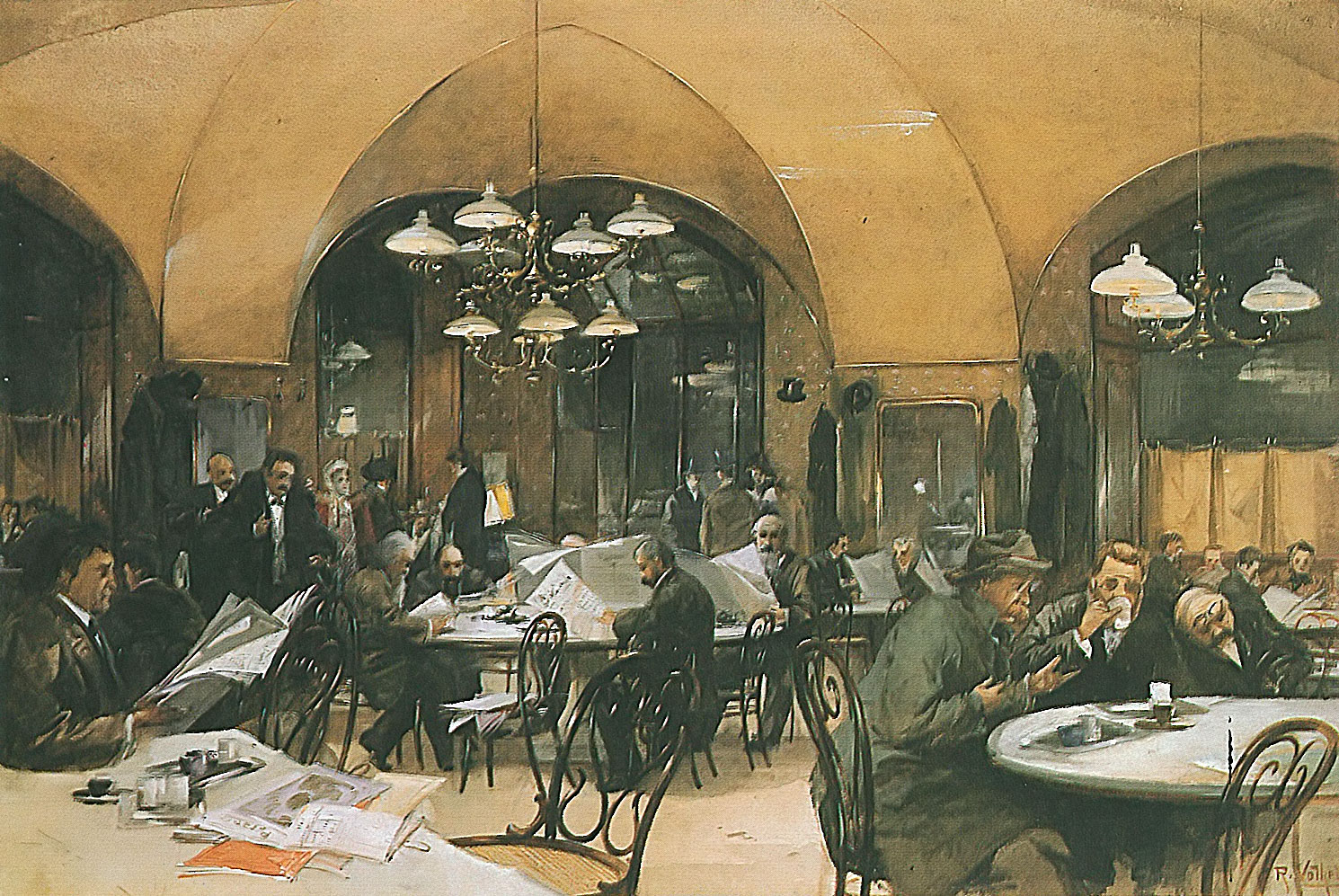
That moment — fin de siècle (end of century) — was defined by a peculiar historical condition: the old order was dying, and the new had not yet been born. The Habsburg Empire was in terminal decline; its political certainties, its moral frameworks, its artistic conventions — all were crumbling. Into this vacuum stepped a generation that understood that they could not look backward for answers. They had to invent the future themselves, in conversation, in argument, in the ferment of the coffeehouse.
Modern India today is living through its own fin de siècle moment. Even though India is thriving, the "idea of India" is in crisis.
The post-Independence consensus of a curious hybrid of socialist statism, secular pieties, and a defensive, apologetic nationalism is exhausted. Its intellectual energy is spent. Its moral authority is depleted. The old frameworks, whether Nehruvian Socialism or old-school Marxism, whether borrowed from the West or manufactured in labs of the NGO-Industrial Complex, no longer describe the reality of a civilisation reawakening to itself. And yet, the new has not been born.
We are surrounded by the wreckage of a dying order. Our institutions and their custodians question religions but treat the Constitution like a holy book. Our cultural elites borrow every foreign idea that comes their way while adding nothing of value on their own. Masses still cling to tired old beliefs out of habit and comfort. And our public discourse has become so tribalistic that there is almost no room left for honest, open-minded thinking.
Into this vacuum steps Jung Indien.
Jung Indien is a platform for intellectually stimulating conversations — a digital Café Griensteidl for the contrarian Indian Right. We are post-religious, anti-socialism, pro-India, anti-woke, modernist and unapologetically anti-Dehat.
We are post-religious because we believe that religion holds many essential truths and metaphysical insights that have shaped human civilisation for millennia. But we refuse to let any faith dictate our worldview, constrain our intellectual freedom, or substitute for rigorous inquiry. We honour the sacred without being enslaved by it.
We are anti-socialism, not because we lack compassion for the poor, but because we have seen what socialism does. It breeds mediocrity, cronyism, and a contempt for excellence. We refuse to settle for the 2.5% GDP growth rate and a worldview based on noble (and liberal) lies. We believe in dynamism, enterprise, and the unleashing of Indian energy because a prosperous India is a strong India, and a strong India is a civilisational necessity.
We are pro-India because this civilisation possesses immense raw material, demographic vigour, and untapped intellectual capital. But raw material alone is not enough; it requires a fundamental re-orientation. We are not sentimental patriots. We understand that India's potential must be directed before it can take shape into something concrete.
We are equally modernist, in the spirit of Swami Vivekananda. That means we embrace rationalism, scientific temper, social reform, and a forward-looking ethos, while remaining deeply rooted in the civilisational consciousness that Swami Vivekananda himself sought to awaken and modernise. We reject both the sterile imitation of the West and the romanticised retvrn to a mythic past. We believe in evolution, not mere preservation.
We are anti-woke because we reject the totalising moralism of the contemporary West: its reduction of all human complexity to oppressor-oppressed binaries and creation of new victimhood identities every other day. We believe in free inquiry and the courage to think against the grain, even when that thinking offends the sensibilities of the global progressive class.
Lastly, we are also unapologetically anti-Dehat. We are not against our villages or the people who live in them, but against the provincial mindset that has come to define so much of Indian life. Dehat, to us, is a default state of mind: the fear of the new, the comfort in mediocrity, the habit of looking backwards for safety rather than forward for opportunity. It is reflected in much of the anti-development "progressive" commentary every time there is a Dam to be built or minerals to be extracted from the land inhabited by tribals. We aim to be an alternative to such platforms which have come to dominate cultural space.
So, what do we aim to do?
We aspire to earn three of the scarcest resources of the 21st century: attention, influence, and taste.
We aim to be the midwife of novel modernist ideas for the new India yet to be born. Like the writers of Jung-Wien, we do not pretend to have all the answers. We do not offer a programme or a platform in the political sense. What we offer is a space — a space for argument, for provocation, for the kind of intellectual fermentation that precedes cultural renaissance.
We will publish long-form essays, interviews with thinkers of our times, book reviews that contain new ideas, along with translations of old essays, that offer the readers something new to think about. We will champion writers who think for themselves, who refuse to march in lockstep with any tribe. We will engage with the great questions of our time: What does it mean to be Indian in the twenty-first century? How do we reconcile our civilisational inheritance with the demands of modernity? What kind of society do we want to build? And what must we discard to build it?
We will be contrarian not for the sake of contrarianism, but because we are sceptical about the wisdom of the masses and believe that the truth is (rarely) found in the consensus. But in cases where it is heard in consensus, we don't mind being a part of that herd.
We do not know what India will become. We do not know if the new order will be born in our lifetime, or if we will merely be the generation that clears the ground for those who come after. But we know this: the old is dying, and something (new) must take its place.
Jung Indien is our contribution to that birth.
Signing off,
Kavita Rana, Founding Editor
Aditya Chauhan, Founding Editor